
There’s so much…so…birds.

THERE’S SO MUCH.

To write can mean peeling away layers slowly, carefully so as to avoid tearing the thin skin of our outer selves. To write can also mean taking an armful of messy, poorly-balanced thoughts and throwing them onto paper before they drop. Both approaches can have a certain beauty. Sometimes, neither approach does. And in our world today, it feels as though there is so, so much to write about, whether gently or in hurling fashion. Which leads me to a sense of paralysis, where my thoughts race while my words screech to a halt. What can I say? How do I say it? What are the chances that my balanced left/right brain self will alienate everyone on all sides? (The answer to that last question is – HIGH. Chances are HIGH.)

So…when in doubt…birds.

I love birds. I always have. I love them for their existence in nature, in spiritual meaning, in physical presence, in song, in personality. So, while all of our brains are spinning in whichever way yours might be spinning, I will tell you a story about birds.
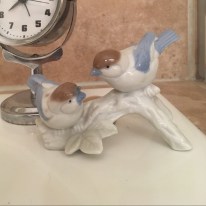
Grandmother's ChickadeesOn the edge of my bathtub, a sacred nightly space for me, sits a very inexpensive ceramic figurine of two chickadees on a branch. These two birds have lived in my home for more than 15 years, but have been a part of my world as long as I can remember, thanks to my grandmother.

A mere six months after I was born in Oak Cliff, Texas (just south of Dallas), my parents packed us up and headed to Southern California, the first of many job-related moves that would characterize my childhood. Growing up in a fairly nomadic family, I did not have a physical “home” in the way many children do. My parents, loyal Texans that they are, maintained that Dallas was HOME. We were always “Texans in [fill in the current state/country]” and that was that. Therefore, “home” was split between our grandparents’ houses in Oak Cliff.

My two sets of grandparents lived a very short distance apart, and our trips home to Texas involved sleeping at both houses by turns. Each held its own particular allure for us as children, a subject I could go on and on about with great sentimentality.  For the purposes of this story, I’ll restrain myself (you’re welcome) and stick to my paternal grandparents’ house on Perryton Drive. Their 1950s home had two bedrooms and about 1300 square feet; sleeping an additional five people took creativity and a “camping out” mentality. The front door opened directly into a formal living and dining, and the opening from one to the next featured cool geometric shelves on either side. On those shelves sat what we would call “special things” – small decorative items my grandmother loved. There wasn’t anything of great value, looking back, but they were all special to her and therefore off limits to us. The exception was the aforementioned ceramic chickadees.

For reasons unknown, I loved those from the time I was a tiny girl. I bunked on the camp cot right next to those shelves (while my older brothers slept luxuriously on the pullout couch), and perhaps as a goodwill gesture, Grandmother would let me play with the chickadees. I have drowsy-edged memories of snuggling on the cot in the dark, a distant murmur of adult voices and occasional kitchen sounds in the background, my imagination running free as I moved the chickadees from shelf to cot and back. Those birds were my friends, and when Grandmother finally left us at 93 years old, they came to nest in my home. They’ve survived several moves – barely (thank goodness for super glue). I think in many ways, they represent for me the strange mix of tenacity, beauty, specificity, adaptability, freedom, and risk that life requires.

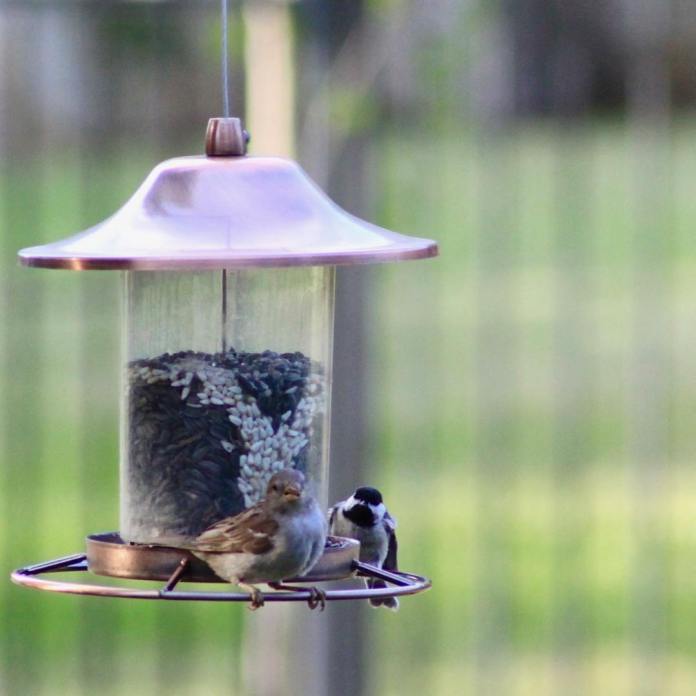
Fast forward a few years to last summer. Having experienced a series of extreme lows and highs in a scant few months’ stretch, our hearts were all a bit tender. I had never really discussed my love of birds with my husband, in all honesty. I simply held it in my heart, knowing that he lives there as well and would therefore understand. While I was out of town one weekend, he rearranged our bedroom so that our chairs faced the large window that looked out into our courtyard-like backyard and fountain. He then proceeded to pull together what was essentially a bird sanctuary. He considered the existing placement of trees and water features, then added plantings and several feeders with different seed to attract the songbirds I love. That window became our favorite place to be. It was slow going at first, with a few fairly disinterested house finches flying by briefly but never staying. Until one day, when my husband called me urgently but quietly to come to the window. There, on a branch next to one of the feeders, was our first real customer: a Carolina chickadee.

I had never seen an actual, live chickadee up close like that. I was riveted as he hopped from the branch to the feeder, picking through his options until he found the safflower. I held my breath, willing him to stay so I could study his tiny, perfect form and coloring.  He obliged for a moment; then, seed in mouth, he took off for the woods behind our house, with his distinctive waving flight pattern. I realized I was still holding my breath and turned to my husband. “Did you see that? It was a chickadee! Our first bird is a chickadee!”

It was one of those moments when I felt utterly and completely loved. Loved by my grandmother many years before. Loved by my mother, who made sure those chickadees came to me. Loved by my husband, whose heart was struggling to heal from the grief of losing his father, but still considered me. Loved by God, who so often uses birds in the Bible and in nature to paint a picture of His love and care for us.

It was less than a year later that we sold that house and moved to our current home. A part of me was devastated to leave that sweet window.  We had amassed a diverse population of birds, all precious to watch. It was no longer a sanctuary just for birds. It was my sanctuary, too. But when we came to see our current house for the first time, we were greeted by a robin’s beautiful song. We stepped onto the patio in time to see her singing away in a mountain laurel before taking flight. I looked at my husband and he looked back at me, and that was it. A few weeks later, I placed my chickadees on the edge of my new bathtub, and whispered to myself, “Welcome home.”
chickadees


Standard

Moving from Talking to Conversation

9E395AE7-211C-491C-AEEA-F0EC84843E6E.jpegI’ve always been a talker. Although I am an introvert by nature, I’m an introvert with a lot to say. Anyone who has sat under the teaching of my mom has heard the story of me and the grandfather clock. I know this because, my entire adult life, I have met people who respond to my introduction by saying, “Oh, you’re the one who had to stand in front of the clock!”

Context: I am a third child with two older brothers, one of whom has plenty to say himself (sorry, but it must be said!).  I was four when my middle brother started Kindergarten, leaving me with the house – and my mom – to myself.  After a few days of crying into my snack plate in front of Mister Rogers, it hit me.  There was no one to compete with. I could say anything I wanted, any time, and no one could interrupt me.  Argue with me.  Override me.  It was Go Time, and go I did.

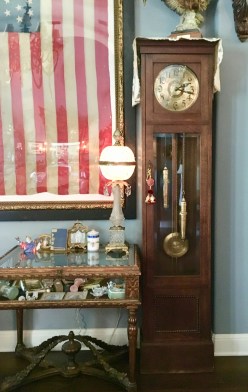
My poor mother, who took homemaking very seriously and had much to accomplish, quickly ran out of patience as I followed her from room to room, pattering away.  She took me to the grandfather clock and stood me in front.  Pointing at the face way up high, she told me, “This is the big hand, and this is the little hand. When the big hand gets to the 2, you can talk again.”  (Before everyone fires off judgment about my mom, it was maybe five minutes, and I don’t blame her – I’ve done the same thing to MYSELF from time to time!)

As the story goes, I stood perfectly still facing the clock, hands clasped behind me, my gaze on the clock face never wavering.  The moment the big hand hit the 2, I was off and running…chatter chatter chatter. But according to my mom, a stay-at-home wife and mom in the 70’s living in a new place and still somewhat isolated, it was five minutes of heaven.

So, for more than 40 years, I’ve been famous for talking.  Again, I am an introvert so I wasn’t one who would talk to a wall, but in my circle of comfort, nobody could beat me for talking.  But as I grew up, something became very clear to me.

Talking and conversation are two very different things.

I have spent a great deal of my adult life purposefully trying to learn the art of conversation.  It’s not rocket science, but it can be hard to do.  I started this blog originally, years ago, because I tend to end up in very interesting conversations and I didn’t really have anywhere to put that. The reason I fall into these conversations is that I’m not afraid to talk about anything, with the right prompt and the right person.

I feel that conversation, as a daily art, has taken a real hit over the last few years. Digital conversation has opened so many doors of dialogue, but one of the unintended side effects is our inability to have a live, in-person conversation effectively. I was thinking about the art of conversation this week because someone I’ve known for a relatively short time was asking me why I’m in fundraising when I hate selling. It’s a common question for someone outside the philanthropy field, because there is a perception that development is selling. To me, fundraising is just a conversation about opportunity, and that conversation requires skill.

I think there are people who are, by nature, sparkling conversationalists. They are witty and thoughtful by turns, and it seems effortless. For the rest of us, it’s a good idea to keep a couple of methods tucked in the back pocket and put into practice whenever necessary. Time and trial has given me two strong concepts that serve me well when I am wise enough to use them – listen and ask.

This order – listen and ask – is very deliberate. To implement ask and listen is to essentially turn a conversation into an interview. Ultimately, that ends up one-sided, and the other participant(s) will walk away feeling vaguely disconnected. When you are raising support, that’s an obvious problem, but it’s just as much of a drawback when you are building a relationship or trying to get something done. So, I stick with listen and ask. Again, this is not rocket science, but I think the state of conversation in our world today affirms that knowing something and doing it are two very different things!

Listen. My husband works with someone whose mastery of this concept has greatly influenced my treatment of important conversations, particularly those that are difficult or potentially emotional or contentious. In one of their first meetings together, Ryan noticed that his partner said very little and allowed the other people to talk. Even when faced with comments that perhaps would inspire a rise to defense, he generally stays quiet. LISTEN has a huge effect on both positive and negative conversation. In a positive environment, to listen is to affirm to your conversation cohort that you are a safe space for them to authentically participate and be vulnerable. Does that sound a bit precious?  Yes, it does, and some conversations never reach any significant depth. However, I like to keep options open, because you never know when a fairly shallow conversation can take a dive toward something more meaningful. When people feel heard, they tend to invest more in the conversation, and in turn the relationship. And what is life, if not an array of relationships?

In a negative or potentially contentious conversation, to listen is to facilitate one of two excellent outcomes: other people eventually move past a venting/emotional phase into a more receptive frame of mind (hence turning the conversation from a negative to a positive), OR, honestly, other people bury themselves. I had a recent opportunity to enter a negative conversation and very quickly realized that moving it to a positive was simply not going to happen. So I chose to channel Ryan’s partner. By listening and NOT TALKING except when necessary, even in defense of myself and my own viewpoint, I was able to exit the conversation with integrity intact and no regrets.  And the other person in the conversation was revealed.

(Of course, anyone who has spent time in effective debate knows that listening is a tool for effective argument. You have to know what you are debating, and you will only really learn that through listening.)

Ask. Sometimes conversation flows easily and naturally. Sometimes it is awkward and bulky!  When this happens, you can choose to gracefully exit and move on. Except when you can’t. Perhaps it is a professional connect that I have to cultivate. Perhaps it’s a new family member with whom I need to form some basis for amenable relationship. Or perhaps it’s someone who doesn’t feel comfortable enough with me to invest.  That’s when ASK can come into play. Uncomfortable or unnatural break? Ask a question. No one knows everything about anyone. There is ALWAYS something you can ask. I have developed this mindset firsthand in my own home. For years, one of my children had a tendency to make very unusual statements with zero context or background. I quickly learned to ask a follow up question, and when I did, it was amazing what I learned and where the conversation moved. So I naturally developed this habit and have taken it to the outside world, with great results. Again – I’m not talking about interviewing people, firing questions until they have that deer in the headlight look (my degree is Broadcast Journalism, so believe me when I tell you I could do that in a heartbeat). But ASK can be a great tool for conversations, both pleasant and challenging. Misunderstanding can kill a conversation; a well-placed question can rescue not only a conversation but a relationship.

Developing the art of conversation is an ongoing journey, and I don’t believe we ever arrive. I still struggle with being a talker, and as I mentioned parenthetically above, I still stand myself in front of the invisible clock. But I like to think that I am gaining ground in professional and personal maturity. Doing so results in better conversation, which leads to better relationships, which culminates in a better life.


Standard

The Power of Three

I’ve been gone from this space for a very long time.

(Three years, in fact.)

Right around that time, I read a blog that talked about the loneliness of parenting preteens/teens, in part because the constant conversation and public sharing dwindles and stops as your children grow and earn the right to choose what they show the world about themselves. That concept – a young adult’s right to own his or her public identity without we parents shaping it alongside them – hit me very strongly. And because so much of what I learn daily is somehow intertwined with teenagers (either mine, or members of Ryan’s teams, or even my students during my sweet interlude teaching high school French), I realized how difficult it would be to write and yet be mindful of that. So, I stopped. Aside from the occasional, lengthier-than-usual social media post, my words have been locked up tightly for right around three years.

A lot has happened in that three years, in our little world. Final goodbyes to middle school. Job changes and detours (including the aforementioned interlude teaching French!). History-making accomplishments by both of the Kjos men for Gateway. Cancer. Unexpected loss of a parent (for us and for others we love). Friendship beginnings and endings. Another move. School changes. Church changes. More dog adventures than we bargained for (I’m looking at you, Lowry). Dating. Driving. New sports. New hobbies.  Poor decisions. Amazingly wise decisions. Parenting struggles. Teenager survival struggles. CRAZY amount of change in society. Growth and setbacks in our family relationship and identity. And most of it played pretty close to the vest.  I’m sure you can all relate (except perhaps to Lowry, because there is only one Lowry – he’s a future blog post, believe me).

I find that God usually speaks to me through other people, in triplicate. Seriously. Almost without fail, three different, unrelated people will say the same thing to me in a fairly short period of time. Perhaps God knows I’m not always the savviest about connecting the dots, so He makes them impossible to miss. Fortunately, while I still wouldn’t call myself savvy, I’ve definitely matured in my ability to see and respond to what He is saying to me through others. So, when I was “encouraged” to start writing again on three separate occasions, by three people in my world who do not know each other, I decided to listen. Is this the best time in my life to try for consistent writing? Nope. Do I still battle that awkward feeling about blogging (because it does feel so narcissistic and “look at me” although I do NOT feel that way about bloggers I read!)?  Yep. But even just this summer, I have learned – and learned well – that when God tells me to do it, however He chooses to tell me, I better do it, because that’s when life really happens. (And your last argument falls when your teenage son says, “Go ahead and write about me, I don’t care!”)

So, hello again. And please be aware in advance that I wholeheartedly agree with William Faulkner when he said, “Get it down. Take chances. It may be bad, but it’s the only way you can do anything really good.”


Standard