Flawed

No one likes perfection in a person. Who can relate to that? Even those who aspire to it are quick to distance themselves from that aspiration. Our imperfections make us who we are. They set us apart as individuals, unique in our exact jumble of good and bad qualities, and relatable in ways we couldn’t otherwise be, were we not so flawed. Right?

“Don’t go changing to try and please me / you’ve never let me down before … I love you just the way you are”

I can appreciate this widespread sentiment but in human nature it’s simply not true, and I wish the world would be honest about it.

The imperfections that make each of us a “one-of-one” human are beautifully celebrated in books and movies and songs and art. That’s the formula, right? Flawed human faces challenge, tries to be perfect and fails, embraces imperfect self, then succeeds (and gets the guy/girl in the process). We love this idea because it means that our inherent value as a person is more important in society than the person we wish we could be (or think we should be). That people resonate with us not in spite of our flaws, but in some ways because of them. We want to think that when things go south and we are revealed for the messy, flawed people that we are, those around us will see that humanity and soften in the face of it. Their anger or frustration at our wrongdoing, whether good- or ill-intentioned, will turn almost immediately into forgiveness and (more importantly) a path forward with no looking back. Maybe a beat or two in there where one wonders…is this it? Have a I truly messed this up forever? Before getting the inevitable, positive response. Of course you are flawed, we all are, that’s what makes you YOU and that’s all we want you to be! All is well.

It’s romantic to think that the very qualities about us that frustrate – or even hurt – others are indeed the things that make us interesting, engaging, memorable (in a good way). What a relief if we can lay down the burden of trying to do everything right, all the time, to the best of our ability. But, to cite a fairly superficial example…when someone prone to absentmindedness forgets to pay the light bill again and house goes dark, the inconvenience and cost of setting things to rights again falls on another person – one who isn’t prone to absentmindedness – and how lovable does that imperfection feel then?

There is one consistent point at which we celebrate a person’s flaws, and that is when they are gone. It’s amazing how death clears a path for us to appreciate and celebrate imperfection. Suddenly, that absentmindedness that generated so many fights in life becomes a loving differentiator. A person’s constant habit of exaggeration draws affectionate laughter: “you had to take every single thing he ever said with a giant grain of salt.” A wild, untamed spirit is remembered as a sort of passion unmatched by other, more ordinary people. A person willing to do anything (right or wrong) to protect their people is a hero.

The hard question: did we really feel that way when they were alive, or is it possible for us to be nostalgic for these qualities because they don’t impact us anymore?

I have a certain skillset that, humorously, calls to mind Colonel Jessep in A Few Good Men – you want me on that wall, you need me on that wall. It’s not an unfair comparison and I won’t pretend that it doesn’t mean that sometimes I might choose a terribly flawed path in protection of the world I love. There’s a bible verse that speaks to this push-pull in I Samuel, where God says “…men judge by outward appearance, but I look at a man’s thoughts and intentions.” Because I know my own flaws and also my own motivations, I am trying in my relationships, close or superficial, to use this filter – on their actions and on mine. When it comes to flaws, I want that hard question to be an easy one. I want the appreciation I have for people after they are gone to mirror the here and now. I’m not naive enough to expect the same from others; perhaps the greatest flaw (perfection?) of them all is to do exactly what you want to do without consideration of whether others would do the same for you.
Standard

Curated

I’ve wrestled with writing and with expressing creativity in general. If you’ve spent any time in this space, you are as painfully aware of it as I am. It has never been about the commitment to consistency or the love of translating experiences and feelings into words on a page. I think the struggle lies in the why of it all.

I’m slowly learning that writing has shaped the person I am inside, as I have sought to understand how to move through this world and with these people in different seasons. Both my writing and the words of others have helped name my reactions and responses to the good and bad that share space uneasily in the world and in my own inner self. As a child, I would discover a clearing in a forest, sun filtering through leaves. A magical space where silence wasn’t actually quiet but was simply the absence of the riot of noise we produce as humans moving through our modern life. Such a discovery would produce feelings that were deep and important, and I didn’t know how to understand the literal pull of longing I would feel. Then I would read the writing of LM Montgomery as she drew out both descriptive details and illustrated with words the bigger picture, and something inside of me would sigh with the relief of resonance. It is a very specific feeling; even trying to say it here feels inadequate and disrespectful of its heft.

While this would not have been true when I was younger, I suspect that the constant chase to document all of life in photos is a parallel experience for others. Where I might use words to capture an ephemeral feeling and transform it into something Real that Happened, the camera lens serves as proof that what one sees actually existed and meant something. I’m not opposed, although I tend to capture on film (file?) an image that will bring something back to me specifically but not necessarily mean anything to an outside viewer. (Moment of truth: this is true in my writing as well, which likely makes it fairly bewildering to many readers) Perhaps we all have a way we try to identify or categorize or codify our feelings into something that proves we were there.

In today’s world, I worry that in the spirit of progress and the better way, we are killing our inner drive to truly know ourselves. Somehow, we seem to take a good idea or tool and skip right past its best and highest use. For centuries, large people groups lacking formal education could not write. Expression happened through oral history and storytelling, but how often does one sort out their own personal feelings in that manner (and in a world where life was hard, hard, hard – who had the time to do anything beyond carry forward history)? With the spread of education came the ability to write, and from that an even larger group of poets and novelists emerged, helping put permanence to experiences and training generations of readers that they could do the same for themselves. But even as we discovered so many outstanding voices capturing generational human experience in words, Artificial Intelligence has now crept in to say, I can do that for you. If you already did it yourself, I can make it “better”. I can learn about you and then shortcut you to success. I can curate for you. I can curate you.

Similarly, the widespread accessibility of cameras and affordability of production and storage via digital format opened the door for amazing everyday people to document life in meaningful and beautiful ways. However, on the heels of this discovery came the online social media platforms, which lured us in with their ease of sharing and then turned on us, overwhelming us with the Algorithm that very authoritatively shows us the best way – the only way – to dress or travel or style our hair or pose with friends or position our couch. This algorithm, so difficult to manipulate, feels like literal brainwashing in its unending, inhuman dedication to curate our lives to its specifications.

The why of creativity is easily lost in a fast fashion world of expression. I think this is what stops me from putting words where anyone can see them. But I’m slowly coming to see that real writing is a form of rebellion. It is messy and riddled with less-than-ideal word choices and unclear plotlines and unnecessary punctuation. My writing is, anyway. I don’t claim to be A Writer, but perhaps there are plenty of those out there already. Perhaps the world can use a few people who just want to translate what’s inside into words on the off chance that they might be better understood for who they are – and show others they can do the same. Perhaps, perhaps.

Standard

October Morning

Written in haste, not care, so as to capture a feeling slipping rapidly away with the rising of the sun

Over the last few weeks or perhaps months, my nights have looked like a cliche. All the online chatter about 3am wakeups is either contagious or simply true; no matter how I am living my daytime hours, it seems that everything conspires to wake me up in the wee hours, when the existential crises of this particular time and place in life come out to play. Yes, I’ve tried the eye gymnastics and “writing it down” and leaving the bed for a quiet, dark space. The awakenings persist; even hormone therapy no longer holds the line for me.

However, there is virtually always a good side to the bad…the proverbial silver lining. This morning was a magical testament to that truth.

After waking a bit later than the usual window (but far earlier than necessary to begin the day) and making the obligatory trip to the restroom, I heard something. Sound seems to carry farther in the dark; with no light on and the trees outside the window crowding out any ambient light, the darkness itself felt loud as I stood completely still. And there it was – again – that sound. The quiet, understated hooting of a Great Horned Owl.

Now, this isn’t terribly unusual for this area, although in my six years in this house, I’ve heard an owl maybe once or twice. However, the magic of that sound coupled with a dark October night was mesmerizing. I had to hear it outside for myself (was I simply imagining things?).

October has long been my favorite month. As a young child in Louisiana, our behind-the-fence neighbors were empty nesters who still had all the trappings of the “fun house” for children, including a trampoline. But what I loved most in their collection was a magazine for children called Cricket, which featured narrative stories, poetry, craft ideas, and games. My favorite issue was October, full of changing leaves, spooky tricks and treats, and allusions to the softening of life following the hard work of the harvest. There was a very real pull that I did not fully understand as a child but certainly resonated with. I carried that issue with me for years, and as it disappeared in one move or another, kept its spirit. It was an absolute serendipity, many years later, that I was engaged and then married in October, sealing its status as my favorite for all time.

So – anything that happens in October feels magical, nothing more so than hearing that owl in the darkness. I had to know if it was real. So, downstairs I crept, slipping on shoes in the mudroom and opening the front door as gently as possible. Closing it behind me, I stood still for a moment, feeling the unfamiliar coolness of dry, autumn air (the first of the year). And there it was – hoo HOO, hooooo, hooooo. As I looked up and around to see where it might be, there was the moon, a bowl cradling Jupiter in the night (morning?) sky. And I heard it again…and the answer from another. Enchanted, I sat on the front step, next to the pumpkins we placed just a couple of days ago. In the stillness, I listened as the answer of a third owl emerged.

A dark sky with a stunning show in the Heavens. Cool air soothing a body (and mind) in fight or flight. Gentle moonlight revealing ordinary trees and rocks and pumpkins as the faeries’ domain. And the ancient, mysterious sound of the owls, calling to one another long before anything else stirs. Were it not for the dreaded wee hour awakening, these moments of magic would have passed, unknown to me.

What a gift, is October.

Standard

Does anyone really know what they are doing?

Another long break in this space. Offline of this blog, I did, in fact, keep writing, although not every day.

I continued the Writer’s Challenge for two cycles, and ultimately decided it wasn’t for me. My goal was to put my writing out there for useful, meaningful feedback. But what I really needed was feedback from writers I could trust…not necessarily other writers like me! In the end, the ROI just wasn’t there for the time spent on my end.

In an effort to force myself back into a state of challenge and risk, I did an experiment earlier this year where I painted daily for one month, and wrote a poem for each painting, then published the entire thing on an instagram account.

It was humbling. It was scary. Because I want to be good. Really, really good. People who love me think I am good (as one does, if you love someone). It’s not ego that drive the desire to be excellent, truly. I just don’t want to answer Mary Oliver’s question about my one wild and precious life with waste. If there is a better way or medium for me to examine my thoughts, wrestle with the questions that refuse to scatter when I shoo them away, pour out this fullness of color and concept and love and grief that springs up in me all the time…I want to find it. I want to do it.

But if I’m being completely honest, I don’t know what I’m doing. I really don’t. Sometimes, in any part of my life. What a relief when someone put a name to “imposter syndrome” because man, does that capture my feelings to a T. It is completely irrational, which is what makes it so difficult to battle. I can logically list out my skills and abilities, the mastery of which have led to success in multiple settings and to varying degrees. But the whisper creeps in…did I really know what I was doing, or did I get lucky? Do I have everyone fooled? And when that ends…what then?

If I sit in the morning stillness and think, who am I at this moment, it is likely I will feel a youthful inadequacy that clearly does not match up with my age. My husband had a business partner who, when asked his age, would answer, “chronological or biological?” His physical and mental health (biological) belied his age (chronological). I often feel a complete disconnect between my chronological and biological selves. Sometimes that is a good divide, as I tend to have an optimistic viewpoint that refuses to let chronology determine how life unfolds. Other times, it feeds that feeling of inadequacy. I’ve been a “fake it ’til you make it” lady for the better part of 30 years, but at what point do you call it – “I made it!” – and lay that down?

I have a deep internal faith and relationship that I don’t like to explicitly put out into the general world. It is too real, meaningful, grace-driven, love-based to open up to the great internet masses; for me, it is best shared on a personal basis rather than thrown out for the wolves to attack. But that faith includes an understanding of my value to One who created me, exactly me, as I am. A verse that comes to mind for me in a regular cadence is “…taking every thought captive in obedience to Christ” (2 Cor 10:5). If I feel – know – that I was created, individually and specifically, then thoughts that push back against my value have to be taken captive.

Genuine assessment that results in honest conclusion that you actually don’t know what you are doing is fair, wise, and part of an examined life (because no, not everyone can know how to do everything). There are many, many people doing damage everyday because they refuse to conduct such an assessment (or don’t have the courage, intelligence, or encouragement to do so). But I think of how many of us there are, walking through our days allowing that insidious whisper of “you don’t know what you are doing” to dull the colors of our contributions to our communities in our homes, workplaces, schools, relationships.

However, there’s another part of me that hears that whisper, comes to a standstill, and then says…so? So what if I don’t know what I’m doing? Does anybody know what they are doing? Is the measure of life well spent really based on achieving expertise or success? Or is the miracle and beauty of life BEING and DOING?

When I’m brave, I see clearly that the whisper is a lie – not that I actually do know what I’m doing, but a lie that having it figured out and buttoned up and foolproof means absolutely anything. If I want to write, or paint, or create, I should do it. I should just do it. And how anyone else feels about that is completely irrelevant.

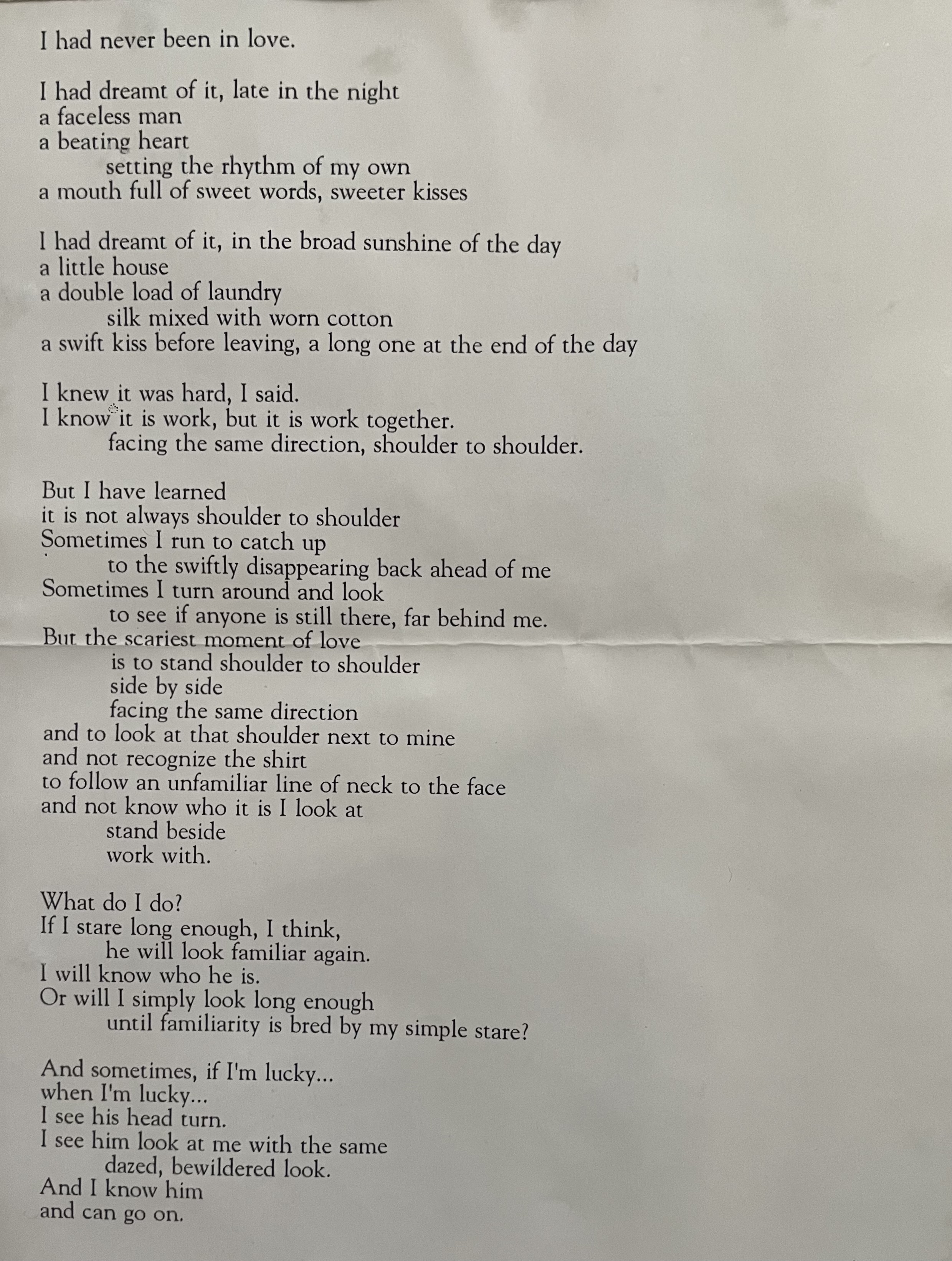
I recently found proof of this when going through several boxes of memories and unearthed a poem I wrote, more than 30 years ago. I don’t remember but can only imagine the level of courage I summoned to write and gift this to my then boyfriend, now husband. In rereading it, I am amazed at prescient it was. There was no way for me to know this, and yet, something in me felt it and put it to paper with hope. So I leave this rambling, inconclusive post with this:

Untitled, 1994

Standard

What is good writing, really?

DAY NINE.

I wrote earlier about participating in a Writing Battle, suggesting that I might post that short story in support of the accountability I am seeking in this exercise. As it turns out, the rules do prohibit that. I characterize myself generally as a rule-follower, for a few reasons. The reason most people don’t know about? A theory, tested and supported over years.

Anarchists (to a greater or lesser degree) by definition defy all rules and thus, society tends to dismiss them or compartmentalize them away from credibility or acceptance. However, when a rule-follower challenges or breaks a rule, people snap to attention. Disrupting the status quo selectively can be a strategic tool for change. Without the identity of breaking-rules-because-I-can, the rule-follower often wields greater power simply by being taken more seriously.

In this instance, I see no compelling reason to break the Writing Battle’s rule, so know that I will post that story when the full Battle is complete and I have permission to do so. However, I’ve been faced with an interesting, additional challenge from the Writing Battle. As participants, we also serve as judges in “story duels.” We are provided two stories, from a different genre than the writing prompt we followed, and are tasked with giving thoughtful feedback to both and selecting a “winner” between the two.

This is hard!

I had no idea how hard this would be.

It doesn’t help that the genre I am “judging” is probably one of my least favorite types of literature or storytelling. I will read anything, and do (I’ve only ever stopped and thrown away, literally trashed, one book in my entire life – it was so badly written as to be virtually unreadable). I exist as a reader with virtually no standards, seeking to enjoy the telling of a story in many forms. Now I find myself forced to choose the better story – or really, the better writing (because the writing uplifts or suppresses the story it seeks to tell).

So, what is good writing? It feels like a specific offshoot of the often-asked question, what is art? Is it something that makes you feel? Is it transporting the reader effectively into another time, world, experience? Must it be impossible to put down, or can it be so powerful as to require breaks in order to process?

I don’t know. If I knew that, I guess I would actually and officially be a writer.

Standard

Write Every Day, Day One

Is there any chance I can actually do this?

In real life, most would characterize me as extremely disciplined. Which I generally am, although not by nature. My true self dreams of sitting in filtered sunlight, reading a not-terribly-highbrow book while snacking on chips and a Diet Coke. Preferably with the ocean’s soundtrack and an onshore breeze. This fact seems to surprise those same people.

I am disciplined not by nature but by necessity. The past three decades required it. I look to the first two years after college, working in a professional setting while maintaining a long-distance relationship that ultimately led to marriage. The early days of supporting my husband’s business, which required me to drive directly from my 9 to 5 job to man the front desk until close (meaning that having dinner to eat in the car required preplanning before leaving the house in the morning, because there was no money to drive through somewhere every day). Having two children under two years old as we stretched again in opening a second business, with a household budget equally stretched, making every moment of naptime or Mother’s Day Out fully productive to keep life running. Menu planning down to each meal of each day in order to successfully navigate everyone’s practices/games/lessons/church activities. Making a “cleaning schedule” for Saturday morning, assigning an exact timeframe to each area of the house and, if I completed that area in a shorter amount of time, giving myself the leftover time to read and snack (a common theme for me).

I wanted it all. A husband pursuing his dream business rather than just doing some job for someone else. Children with a variety of options to develop skills and interests that build brain, body, and spiritual growth. Meals that gave everyone the best chance at good health and happiness. A warm, welcoming, clean home as a place of retreat and rest. A separate business to use creative and strategic skills to financially contribute to the family. A place (emotional and physical) for friends in need to come for peace. An anchor for the family ship in any kind of weather.

Discipline doesn’t help achieve these dreams. These dreams demand it. Discipline says, “If you truly want this, I am the way.” I wanted it. Discipline delivered.

I now occupy a very different reality. With adult children very nearly launched, our household of two ebbs and flows more easily through those dreams. The beautiful outcome of years of discipline is a lightening of its load. With that in mind, I turn to the mirror to see what else lives there – what came before those decades we have moved through. Writing was one such dream, occasionally surfacing across the years but never calling out for its due attention. And here I sit, struggling as new openness and availability battles with a lack of discipline around this particular art and expression.

The primary element – excuse? – that always freezes me into inaction is fear. Why should I write publicly? Isn’t that implying that people should be reading what I am writing? Why would anyone want to read what I write? Even asking that question feels wildly uncomfortable, knowing that it could be perceived as fishing for compliments or affirmation (neither of which is the case). Having grappled with this feeling for years and conveniently finding no good time to come to resolution, I find that good time is now. Do I write because I care what other people think, or because there are words that want to get out and I need a place to put them? Certainly the latter. My husband told me he wishes me to write so that there is a record, in my words, out in the world. A record of what, I ask? Nothing in particular, he says. Just your words. The things you think and say. The air doesn’t hold them; writing does.

So I decide it is time to write. Writing in public, as the internet certainly is, ultimately serves as accountability. If I can learn discipline around things no one loves (cleaning bathrooms?), I can build discipline in this. Starting today.

Standard